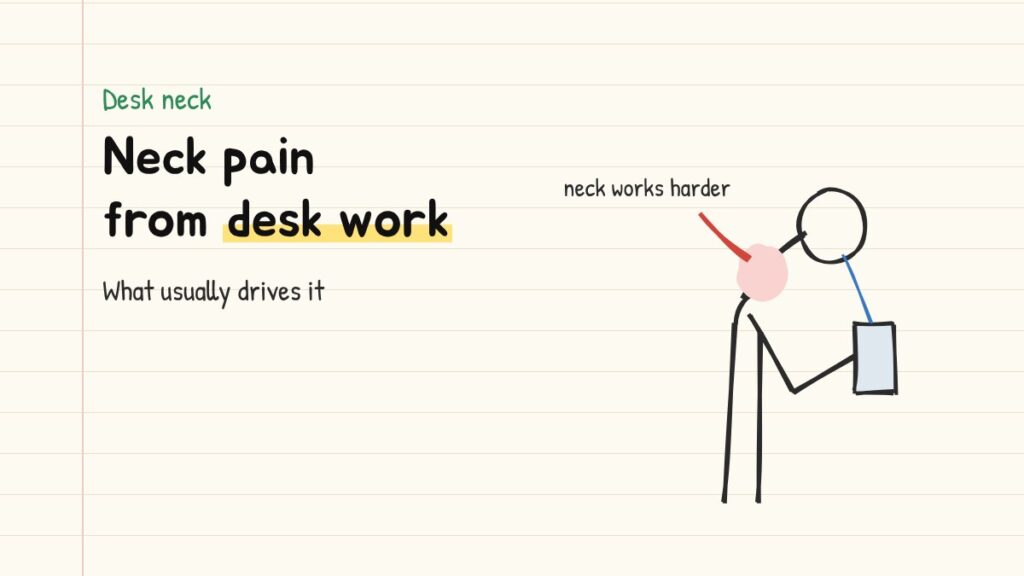
Quick answer: Most desk-related neck pain comes from staying in one position too long, not from a single “bad posture.” Small changes to your screen height, more frequent position changes, and a few gentle moves for your neck and upper back can help many people feel better. If you have numbness, weakness, or other warning signs listed below, get checked by a doctor.
Why your neck gets sore at a desk
An adult head weighs roughly 10 to 12 pounds (about 4.5 to 5.5 kg). Your neck muscles hold it up all day, and they are good at that job. Trouble tends to start when they do the same job, in the same way, for hours without a break.
Think of holding a cup of coffee at arm’s length. It’s light, but after twenty minutes your arm would ache. Nothing is damaged; the muscles are just tired.
When you lean toward a screen, your head drifts forward. The muscles at the back of your neck and the top of your shoulders work a bit harder to keep your head from tipping. Over a long day, that steady low-level effort can show up as stiffness, a dull ache, or a tension-type headache.
Posture matters less than you might think
You may have heard that “forward head posture” causes neck pain. The real picture is more mixed. Research suggests that the shape of someone’s posture is a fairly weak predictor of who gets neck pain. Plenty of people sit with their head forward and feel fine. Others sit “perfectly” and still hurt.
What seems to matter more:
- Time in one position. Long, unbroken stretches of screen time are a common thread.
- Stress and sleep. Poor sleep and high work stress are linked to more neck pain. Tense muscles and a sensitive nervous system can make normal sensations feel louder.
- General activity. People who move more during the week often report less neck discomfort.
So the goal isn’t to lock yourself into one “correct” posture. Changing position often gives tired tissues a rest, and no single position needs to be held for long.
The role of your upper back
Your neck sits on top of your upper back (the thoracic spine, the part of your spine where your ribs attach). When your upper back stays rounded and still for hours, it may stiffen. Your neck then may do more of the bending and turning work.
Gentle upper-back movement can help some people feel looser through the neck, too. The point isn’t to “correct” anything, but to give the whole area more motion to use.
Your desk setup: small changes that may help
A good setup doesn’t prevent all pain, but it can reduce how hard your neck works.
- Screen height. Aim for the top of your screen at or a little below eye level. Your eyes should look slightly down at the middle of the screen.
- Screen distance. About an arm’s length away is a good starting point. If you lean in to read, try making the text bigger.
- Laptops. A laptop on a desk makes you look down a lot. A stand plus a separate keyboard and mouse can help if you use it for long periods.
- Two screens. Put the one you use most directly in front of you, so you aren’t turning your head to one side all day.
- Glasses. Bifocals or progressives can make you tip your head back. Your eye doctor can advise on options for screen work.
A 45-second self-check
Try this while sitting. Move slowly and stay in a comfortable range.
- Turn your head to look over your right shoulder, then your left. Does one side feel tighter or more limited?
- Tilt your ear toward each shoulder. Notice any pulling on the opposite side.
- Look up, then down. Notice whether one direction feels stiffer.
- Check your upper back. Sit tall, cross your arms over your chest, and gently rotate your upper body to each side. Is one side stiffer?
This isn’t a diagnosis. If one of these movements causes sharp pain, pain shooting into the arm, or tingling, stop and skip the exercises below until you have spoken with a clinician.
Gentle things to try
These are low-risk for most people. Mild stretching or a feeling of effort is fine. Sharp or spreading pain isn’t.
1. Movement breaks
How to do it: Every 30 to 45 minutes, stand up, roll your shoulders, look around the room, or walk to get water. Even one to two minutes counts.
Dose: Many small breaks through the day work better than one long break.
Stop if: Standing makes you dizzy or lightheaded. Sit down and mention it to your doctor.
2. Chin nods
This works the small muscles at the front of your neck (the deep neck flexors) that help hold your head steady.
How to do it: Lie on your back with a small pillow or sit tall in a chair. Gently nod as if saying a quiet “yes,” tucking your chin slightly. Your head shouldn’t lift off the pillow. Hold for 5 seconds, then relax.
Dose: 5 to 10 slow reps, once or twice a day. You can build to 10-second holds over a few weeks.
Stop if: You feel pain at the front of your throat, headache, or tingling in your arms or hands.
3. Seated upper-back extension
How to do it: Sit in a chair with a backrest that reaches about mid-back. Place your hands behind your head to support it. Gently lean back over the top of the chair, letting your upper back arch a little. Breathe out, then come back up.
Dose: 5 to 8 slow reps, a few times a day.
Stop if: You feel pinching in your lower back (try sitting a bit taller first) or any pain in the chest.
4. Open-book rotation
How to do it: Lie on your side with your knees bent and stacked, arms straight out in front of you, palms together. Slowly lift the top arm and open it toward the ceiling and then the floor behind you, letting your head and chest follow. Go only as far as feels easy. Return slowly.
Dose: 5 to 8 reps per side, once a day.
Stop if: Your shoulder pinches or you feel pain going down your arm.
Give these one to three weeks of steady practice. Everyday neck pain often improves on its own within a few weeks, and these habits can help that process along.
When to see a doctor
Get help right away (emergency care) if you have:
- Neck pain with chest pain, pressure, shortness of breath, sweating, or pain spreading to the jaw or left arm. These can be signs of a heart problem.
- A sudden, severe headache unlike any you have had before.
- Neck pain after a fall, car crash, or other injury.
- Fever with a stiff neck and headache, or sensitivity to light.
- New trouble walking, clumsy hands, loss of balance, or loss of bladder or bowel control. These can point to pressure on the spinal cord (cervical myelopathy).
- Dizziness, double vision, trouble speaking, or trouble swallowing along with neck pain.
See a doctor soon if you have:
- Numbness, tingling, or weakness in your arm or hand. Weakness that’s getting worse needs same-day care.
- Pain that keeps getting worse after two to four weeks, or no improvement after about six weeks.
- Pain that wakes you at night and doesn’t ease with changing position.
- Unexplained weight loss, a history of cancer, or a weakened immune system.
FAQ
Is it bad to crack my neck?
Gentle self-cracking is very common and is usually harmless. But if you feel the urge constantly, it may be a sign your neck is stiff and would benefit from more varied movement. Avoid forceful twisting, and stop if it causes pain or dizziness.
Should I buy a posture corrector?
Braces that pull your shoulders back may feel supportive for a short time. They don’t seem to train lasting changes, and wearing one for long periods may leave you relying on it. Regular movement and simple strength work are a better long-term bet for most people.
How long does desk-related neck pain usually last?
Many cases ease within a few days to a few weeks. Pain can return during busy, stressful periods, and keeping up movement breaks may help it return less often.
This article is general education, not medical advice. Reviewed by Keunwoo Lee, KMD.