Quick answer: Rounded shoulders are very common in people who work at a desk, and on their own they aren’t a sign that something is wrong. Shoulder shape is only loosely linked to pain. If your shoulders or upper back feel tight or achy, a mix of gentle chest stretches, upper-back strength work, and more frequent position changes are reasonable, low-risk things to try.
What “rounded shoulders” really means
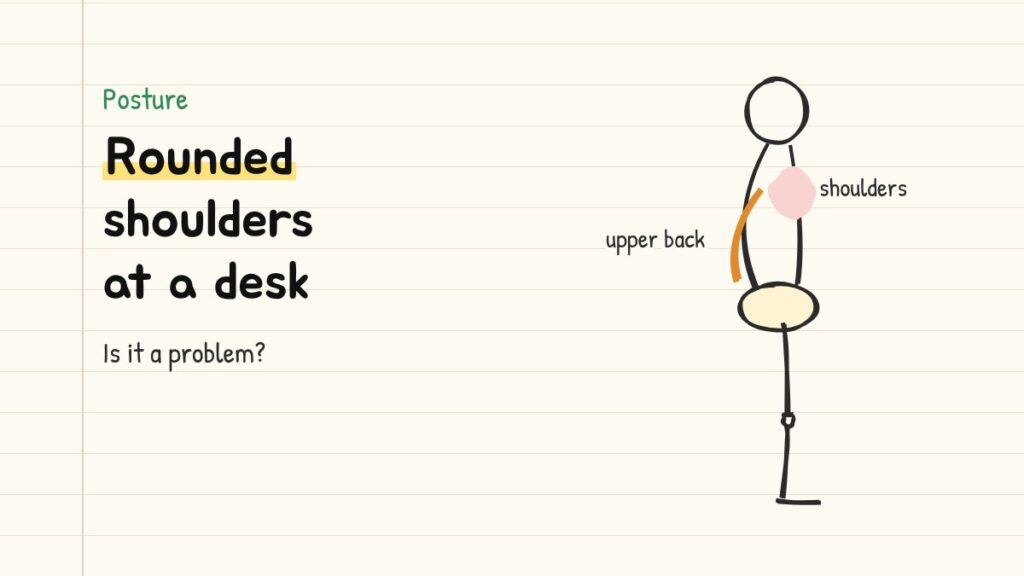
When people say “rounded shoulders,” they usually mean the shoulders sit a bit forward, the upper back curves more, and the chest looks closed. You might notice it in photos or when you catch your reflection at the end of a long day.
This shape is extremely common. Human bodies come in many forms, and there’s a wide range of normal. Some people naturally have more curve in the upper back. Others drift into it when tired, focused, or cold.
The key question isn’t “Do my shoulders look rounded?” It’s “Do I have discomfort, and does it get in the way of my life?”
Is posture the cause of the pain?
For years, people were told that slumping causes shoulder and neck pain. Research suggests the link is weaker than that. Studies comparing people with and without pain often find that their posture looks quite similar. Many people with very rounded shoulders have no pain at all.
That doesn’t mean posture never matters. It means posture is one small piece of a bigger puzzle. Other pieces include:
- How long you stay still. Holding any position for hours, even a “good” one, can make tissues feel stiff and sore.
- Strength and capacity. Muscles that rarely work hard may tire quickly during long tasks.
- Stress, sleep, and mood. These change how sensitive your body is to everyday strain.
- Your workload. Long hours and tight deadlines often mean fewer breaks.
The biomechanics, in plain words
When you reach for a keyboard and mouse, your arms move forward. Your shoulder blades tend to slide forward and around your rib cage to follow them. Your chest muscles (the pectorals) sit in a shortened position for hours. The muscles between and below your shoulder blades sit in a lengthened position, working quietly to hold your arms up.
Neither position is harmful. But staying there all day, every day, may leave the chest feeling tight and the upper back feeling tired or achy. Your upper back (the thoracic spine) may also feel stiff from little movement.
The helpful approach is to give these tissues variety: stretch what has been short, strengthen what has been doing quiet, steady work, and move the upper back through its range.
A 45-second self-check
This isn’t a test you can “fail.” It just helps you notice how your body feels today.
- Arms overhead. Stand with your back against a wall, feet a few inches away. Slowly raise both arms overhead, thumbs leading. Can your arms get close to the wall without your lower back arching a lot? Notice any tightness in the chest or shoulders.
- Shoulder blade squeeze. Gently pull your shoulder blades back and slightly down. Hold for 5 seconds. Does this feel easy, tiring, or crampy?
- Rotation. Sit tall, cross your arms over your chest, and turn your upper body to each side. Is one direction stiffer?
If any of these causes sharp pain, pain into the arm, or tingling, stop and skip the exercises below until you have talked with a clinician.
Gentle things to try
Mild stretching and muscle effort are normal. Sharp, pinching, or spreading pain is your cue to stop.
1. Doorway chest stretch
How to do it: Stand in a doorway. Place your forearms on the door frame with your elbows at about shoulder height. Step one foot forward slowly until you feel a gentle stretch across your chest. Keep your ribs down and avoid arching your lower back.
Dose: Hold 20 to 30 seconds, 2 to 3 times, once or twice a day. You can try elbows slightly higher or lower to feel different parts of the chest.
Stop if: You feel pinching at the front of the shoulder, tingling in your hands, or your shoulder feels unstable.
2. Band pull-aparts
How to do it: Hold a light resistance band in front of you at chest height, hands about shoulder-width apart, arms straight. Pull the band apart by moving your hands out to the sides, squeezing your shoulder blades gently together. Return slowly. If you don’t have a band, do the same motion with no resistance.
Dose: 2 to 3 sets of 10 to 15 reps, 3 to 5 days a week. The last few reps should feel like effort, not strain.
Stop if: You feel pain inside the shoulder joint, clicking that hurts, or neck strain. Try a lighter band or smaller motion first.
3. Rows
Rows strengthen the muscles that pull your shoulder blades back.
How to do it: Loop a resistance band around a sturdy post or a closed door (using a door anchor), or use a light weight while leaning on a bench with one hand. Pull your elbow back toward your hip, keeping your shoulder away from your ear. Pause, then lower slowly.
Dose: 2 to 3 sets of 8 to 12 reps per side, 2 to 3 days a week. Add a little resistance every week or two if it feels easy.
Stop if: You feel sharp pain in the shoulder, pain into the arm, or strain in your lower back.
4. Mid-back extension over a chair
How to do it: Sit in a sturdy chair with a backrest that reaches your mid-back. Support your head with your hands. Gently lean back over the top edge of the chair, letting your upper back arch. Breathe out as you lean back, then return.
Dose: 5 to 8 slow reps, 2 to 3 times a day. It’s a good one for short breaks.
Stop if: You feel pinching in the lower back or any chest pain.
5. Arm and shoulder variety breaks
How to do it: Every 30 to 45 minutes, take a minute to move your arms in ways your desk doesn’t ask for. Reach overhead, make slow arm circles, or reach behind your back.
Dose: 30 to 60 seconds, several times a day.
Stop if: Any movement causes sharp shoulder pain. Skip that one and keep the others.
Give these two to six weeks. Strength changes take time, and many people notice they feel less tired by the end of the workday before they notice any change in how they look.
When to see a doctor
Get help right away (emergency care) if you have:
- Shoulder, upper back, or chest pain with shortness of breath, sweating, nausea, or pain spreading to the jaw or arm. These can be signs of a heart problem.
- Sudden severe pain after a fall or injury, or a shoulder that looks out of place.
- New weakness in both arms or hands, trouble with balance, or loss of bladder or bowel control.
- Fever with a red, hot, or swollen joint.
- Shoulder or chest pain with sudden shortness of breath or coughing up blood.
See a doctor soon if you have:
- Numbness, tingling, or weakness in one arm or hand.
- You can’t lift your arm, or pain keeps you from sleeping on that side for more than a couple of weeks.
- Pain that keeps getting worse, or no improvement after about six weeks.
- Unexplained weight loss, a history of cancer, a long smoking history, or night pain that doesn’t ease with rest.
FAQ
Can exercise change how my shoulders look?
Bodies are adaptable, but the shape of your upper back also depends on genetics, age, and habits. Exercise can help you feel stronger and more comfortable, and you may find it easier to sit tall when you want to. The main goal is comfort and capacity, not a perfect look.
Should I sit up straight all the time?
No. Trying to hold one “perfect” position all day can be tiring in its own way. It’s fine to slouch sometimes. What helps most is changing position often and moving regularly.
Do I need a gym for these exercises?
No. A light resistance band and a doorway are enough for most people. Bodyweight versions can also work, like wall angels or reverse snow angels lying face down.
This article is general education, not medical advice. Reviewed by Keunwoo Lee, KMD.