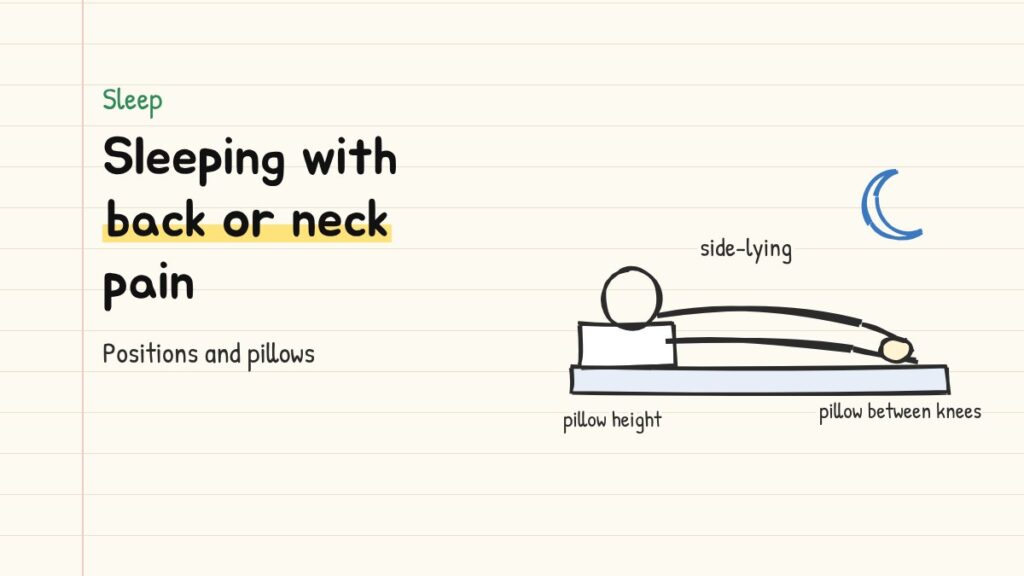
Quick answer: There’s no single “best” sleeping position for everyone with back or neck pain. Side and back sleeping with pillows placed for support often feel most comfortable, and a pillow that keeps your head roughly level with your spine can ease neck strain for many people. A slow, step-by-step way of getting out of bed may also make mornings less painful.
Why pain and sleep affect each other
Pain can make it hard to fall asleep or stay asleep. And poor sleep can make pain feel worse the next day. Research suggests this works in both directions: people who sleep badly often report more pain, and people with more pain often sleep badly.
Small changes in how you lie, and what supports you, may help you rest better, and better rest may help your body cope with everyday aches.
What happens to your spine at night
When you lie down, your spine is no longer holding you up against gravity. That’s generally a good thing. Your discs (the cushions between the bones of your spine) take in a little fluid overnight, which is one reason you’re slightly taller in the morning.
But you also stay fairly still for long stretches. If one position puts a joint or muscle at the end of its comfortable range for hours, you may wake up stiff or sore. Common examples:
- A pillow that’s too high or too low, tipping your neck to one side.
- Lying on your stomach with your head turned sharply for hours.
- Your top leg falling forward when you sleep on your side, twisting your lower back.
- A mattress that sags in the middle.
Morning stiffness that eases within 30 minutes of moving around is very common and usually not a worry. Stiffness that lasts much longer deserves a mention to your doctor (see the list below).
Positions that may help
Side sleeping
Many people find this the most comfortable position when they have back or neck pain.
- Head: Use a pillow thick enough to fill the space between your ear and the mattress, so your head stays roughly in line with your spine. People with broader shoulders often need a thicker pillow.
- Knees: Place a pillow between your knees. This keeps your top leg from dropping forward and twisting your lower back.
- Arms: Hugging a pillow in front of your chest can keep your top shoulder from rolling forward.
Back sleeping
- Head: Use a thinner pillow than you would for side sleeping. Your chin shouldn’t be pushed toward your chest, and your head shouldn’t tip back.
- Knees: A pillow under your knees can take some strain off your lower back by letting it relax into a gentler curve.
Stomach sleeping
Stomach sleeping isn’t “wrong,” but it often turns your neck sharply to one side for hours. If you prefer it and wake up sore, you could try:
- A very thin pillow or no pillow under your head.
- A thin pillow under your hips and lower belly to reduce arching in your lower back.
- Gradually shifting toward a side-lying position with a body pillow along your front.
Pillows and mattresses: what matters
You don’t need a special or expensive pillow. What matters most is height and comfort. A pillow that keeps your head about level with your spine in your usual position is the goal. You can adjust height by folding a pillow, stacking two thin ones, or adding a folded towel.
For mattresses, research suggests a medium-firm mattress may feel better than a very soft or very hard one for many people with back pain. But comfort is personal. If your current mattress sags, rotating it may help as a short-term option.
A 45-second self-check
Try this in your usual sleep position, either in bed or on a firm surface.
- Neck line. Lie on your side on your pillow. Ask someone to look at you from behind, or take a photo. Is your head roughly in line with your spine, or tipping up or down?
- Hip line. Without a pillow between your knees, notice whether your top knee drops onto the bed and your lower back twists. Then try a pillow between your knees and notice the difference.
- Back check. Lying on your back, notice whether your lower back feels strained. Then slide a pillow under your knees and notice whether it eases.
If any position causes sharp pain, numbness, or tingling, change position and avoid it.
Gentle things to try
1. Adjust your pillow height
How to do it: Use the self-check above. Add or remove height using folded towels or a second thin pillow until your neck feels supported and level.
Dose: Try one setup for 3 to 5 nights before judging it. Your body may need a few nights to adjust.
Stop if: You wake with more neck pain, headaches, or arm tingling. Go back to your previous setup.
2. Knee pillow support
How to do it: For side sleeping, place a firm pillow between your knees and ankles. For back sleeping, place a pillow under your knees.
Dose: Use it every night for at least a week and see how your mornings feel.
Stop if: It causes hip pain or makes it harder to fall asleep. A thinner pillow may work better.
3. The log roll to get out of bed
This reduces twisting and sudden effort in your back.
How to do it: Bend your knees while lying on your back. Roll onto your side as one unit, keeping your shoulders and hips together, like a log. Let your legs slide off the edge of the bed. At the same time, push up with your arms to bring your upper body to sitting. Sit for a few seconds before standing.
Dose: Every time you get out of bed while your back is sore.
Stop if: Pain is severe or you feel faint or dizzy when sitting up. Sit still and get help if needed.
4. Gentle morning movement
How to do it: Before getting up, lie on your back with knees bent and gently rock both knees side to side a few times. Then do a few slow pelvic tilts, flattening and gently arching your lower back. Once up, walk around for a few minutes.
Dose: 1 to 3 minutes, each morning.
Stop if: Any movement causes sharp pain or pain down a leg.
When to see a doctor
Get help right away (emergency care) if you have:
- Back or neck pain with chest pain, shortness of breath, or pain spreading to the jaw or arm.
- Numbness in your groin or inner thighs, or new trouble with bladder or bowel control.
- New weakness in your legs or arms, trouble walking, or clumsy hands.
- Fever with a stiff neck or severe back pain.
- Pain after a fall or injury, especially if you’re older or have thin bones.
See a doctor soon if you have:
- Pain that regularly wakes you and doesn’t ease with changing position.
- Morning back stiffness that lasts more than about 30 minutes most days, especially if the pain began before age 45, has lasted over three months, and eases with activity rather than rest. This can be a sign of an inflammatory condition.
- A history of cancer, unexplained weight loss, or night sweats.
- Pain that isn’t improving after about four to six weeks.
FAQ
What is the best sleeping position for back pain?
There’s no single best position. Many people find side sleeping with a pillow between the knees, or back sleeping with a pillow under the knees, most comfortable. The best choice is the one that lets you sleep and wake with less discomfort.
How do I know if my pillow is too high?
If you sleep on your side and your head tips up toward the ceiling, or you wake with a sore neck on the side facing up, it may be too high. If your head sinks down toward the mattress, it may be too low.
Should I sleep on the floor for back pain?
Some people like a firm surface, but there’s little evidence the floor beats a supportive mattress. Getting up from the floor can also be harder on a sore back.
This article is general education, not medical advice. Reviewed by Keunwoo Lee, KMD.