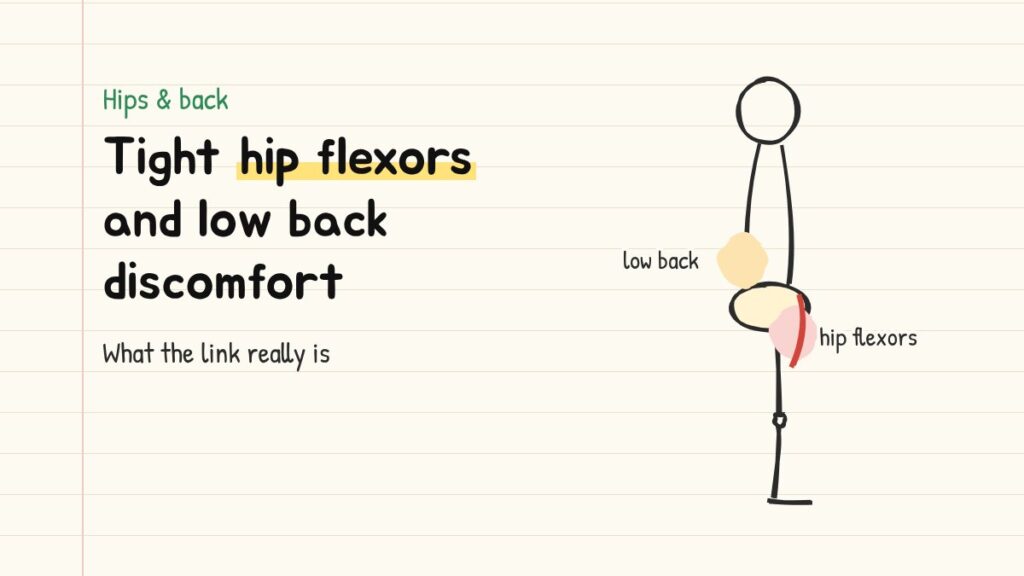
Quick answer: Your hip flexors attach to your lower spine, so when they feel tight, some people notice it in their lower back. But research suggests the link isn’t universal: many people with tight hips have no back pain, and many people with back pain have normal hip flexibility. Gentle hip stretches and glute strengthening can still help some people feel more comfortable, especially if they sit a lot.
What are the hip flexors?
Your hip flexors are a group of muscles at the front of your hip. Their main job is to bring your thigh up toward your chest, like when you climb stairs or march.
The biggest one is the psoas (pronounced “SO-az”). It runs from the sides of your lower spine, through your pelvis, and attaches to the top of your thigh bone. Another, the iliacus, lines the inside of your pelvis and joins the psoas. Together they are often called the iliopsoas. The rectus femoris, one of your front thigh muscles, also helps bend the hip.
Because the psoas attaches directly to your lumbar spine (the lower back), it makes sense that hip flexors and the lower back can affect each other.
How the link might work
Here is the common theory, in plain words.
When you sit, your hips are bent and your hip flexors rest in a shortened position. If you sit for many hours most days, these muscles may start to feel tight when you stand up and try to straighten your hips fully.
When you stand or walk, tight hip flexors may gently pull the front of your pelvis forward and down. To stay upright, your lower back may arch a bit more. For some people, that extra arch and the extra work in the back muscles may feel like an ache in the lower back, especially after standing for a long time or walking fast.
At the same time, your glutes (the buttock muscles) do the opposite job of your hip flexors. They extend your hip, moving your leg behind you. If your glutes aren’t used much during the day, other muscles, including those in your lower back, may pick up more of the work.
Why the link isn’t universal
This theory sounds tidy, but bodies are rarely that simple.
Studies that measure hip flexor flexibility and pelvic tilt often find only small or inconsistent links with back pain. Many people with a lot of pelvic tilt feel fine. Many people with back pain have hips that move well.
A few reasons why:
- Normal varies widely. Pelvic shape and spinal curves differ a lot from person to person.
- Back pain has many contributors. Activity level, sleep, stress, past injuries, and how sensitive your nervous system is all matter.
- “Tight” is a feeling, not always a measurement. A muscle can feel tight because it’s tired, guarded, or sensitive, not only because it’s short.
So, if your hips feel tight and your back aches, working on your hips is a reasonable thing to try. It isn’t a guaranteed answer, and it isn’t a sign that you’re “out of alignment.” Think of it as one useful piece of an active routine.
A 60-second self-check
Do this gently. It’s about noticing, not testing.
- Standing lunge feel. Stand and take a medium step forward. Gently bend the front knee while keeping your back leg straight and your torso upright. Do you feel a stretch at the front of the back hip? Does one side feel tighter?
- Lying knee hug (modified Thomas test). Lie on your back on a firm bed (not too close to the edge). Hug one knee toward your chest. Notice whether the other thigh stays resting on the bed or lifts up. If it lifts, the front of that hip may be tight. Repeat on the other side.
- Back response. Did either position change your back discomfort, for better or worse?
If either position causes sharp pain in your back or pain down your leg, stop and skip the exercises below until you have seen a clinician.
Gentle things to try
Feeling a stretch or muscle effort is normal. Sharp, pinching, or spreading pain means stop.
1. Half-kneeling hip flexor stretch
How to do it: Kneel on one knee with a cushion under it. Put your other foot flat in front, knee bent about 90 degrees. Tuck your tailbone slightly, as if pulling your belt buckle up toward your ribs, and gently squeeze the buttock of the kneeling leg. You should feel a stretch at the front of that hip. You may not need to lean forward at all. If you do, move only an inch or two.
Dose: Hold 20 to 30 seconds, 2 to 3 times per side, once or twice a day. Holding something stable for balance is fine.
Stop if: You feel pinching at the front of the hip, pain in the kneeling knee, or your lower back arches and aches. Adjust by tucking the pelvis more and leaning less.
2. Glute bridge
How to do it: Lie on your back with knees bent and feet flat, hip-width apart. Press through your heels and squeeze your buttocks to lift your hips until your body forms a straight line from shoulders to knees. Avoid arching your lower back at the top. Pause, then lower slowly.
Dose: 2 to 3 sets of 8 to 12 reps, 3 to 5 days a week. Make it harder over a few weeks by holding at the top for 3 to 5 seconds or trying a single-leg version.
Stop if: You feel cramping in your hamstrings (try moving your feet a little closer), or sharp pain in your back.
3. Walking with a longer stride
How to do it: On a flat, safe path, walk at a comfortable pace and let your back leg extend a little more behind you with each step. Let your arms swing.
Dose: 10 to 30 minutes, most days. You can add a few minutes of this to any walk.
Stop if: You get leg pain, numbness, or weakness that builds as you walk.
4. Sit-to-stand breaks
How to do it: Every 30 to 45 minutes, stand up fully from your chair and squeeze your buttocks gently for a few seconds as your hips straighten. Sit back down with control.
Dose: 5 to 10 reps at each break, several times a day.
Stop if: Standing up causes sharp back pain or leg symptoms.
Give these two to six weeks. Muscle flexibility and strength change slowly, but many people notice they feel looser after long days much sooner.
When to see a doctor
Get help right away (emergency care) if you have:
- Numbness in your groin, inner thighs, or the area you would sit on a saddle.
- New trouble passing urine, loss of bladder or bowel control, or new sexual problems. These can be signs of cauda equina syndrome.
- Weakness in one or both legs that’s getting worse.
- Hip or back pain after a fall or injury, especially if you can’t bear weight or have thin bones (osteoporosis).
- Fever, chills, or a hot, swollen joint along with pain.
See a doctor soon if you have:
- Pain, numbness, or tingling going down your leg below the knee.
- Deep groin pain, a clicking or locking hip, or pain that limits walking. These can come from the hip joint itself.
- A history of cancer, unexplained weight loss, or night pain that doesn’t ease with rest.
- Pain that isn’t improving after about four to six weeks.
FAQ
Can stretching my hip flexors help my back right away?
Some people feel a little looser after a stretch, but that feeling is often short-lived. Lasting comfort usually comes from steady practice over weeks, combined with regular movement and strength work.
Does the psoas “store” stress or emotions?
You may see claims like this online, but there’s no good evidence for them. Stress can increase muscle tension and pain sensitivity throughout the body, so relaxation, sleep, and gentle movement can all help.
Should I stop sitting if my hip flexors are tight?
No. Sitting is a normal part of life. The aim is to break up long sitting stretches with short movement breaks and to give your hips some time in the extended position each day.
This article is general education, not medical advice. Reviewed by Keunwoo Lee, KMD.