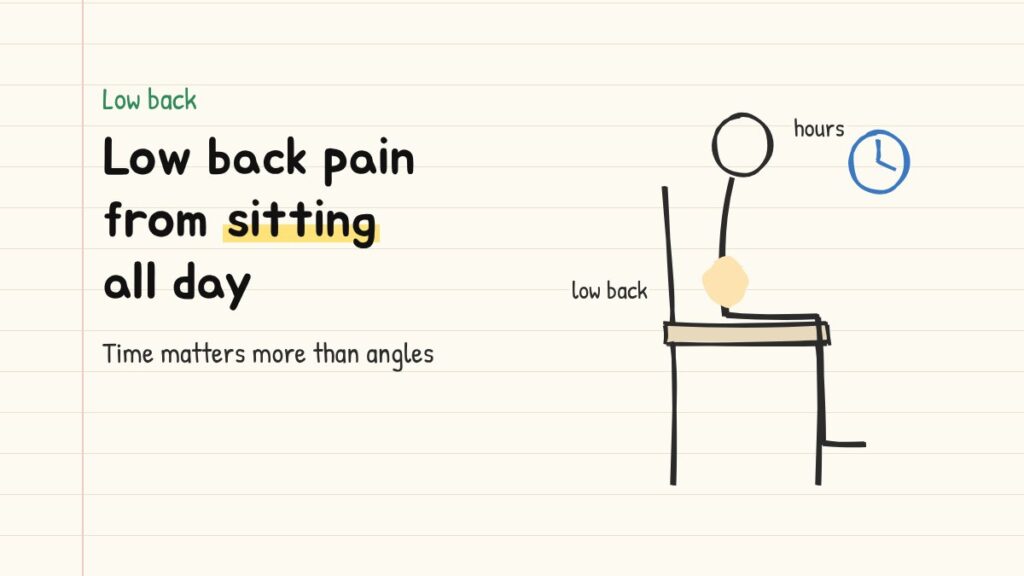
Quick answer: For many desk workers, low back discomfort is linked more to long, unbroken sitting than to sitting with the “wrong” posture. Breaking up sitting time, learning a comfortable hip hinge, and walking regularly are practical places to start. Much everyday back pain eases within a few weeks, but some warning signs need prompt medical care.
Low back pain is common, and usually not serious
If your lower back aches after a long day at a desk, you have a lot of company. Low back pain is one of the most common health complaints worldwide. Estimates suggest most adults will have at least one episode during their lives.
The reassuring part: in most cases, everyday back pain isn’t caused by serious damage. Doctors often call it “nonspecific” low back pain, which simply means no single structure can be blamed. It often improves on its own over days to weeks.
Why sitting all day can make your back complain
Sitting itself isn’t dangerous. The issue is usually how long you sit without changing anything.
When you sit, your hips are bent and your lower back tends to round a little. The muscles along your spine and around your hips stay in one position. The discs between your vertebrae (the bones of your spine) handle a steady, unchanging load.
Your body likes variety. Discs get their nutrients partly through movement, as gentle changes in pressure help fluid move in and out. Muscles and joints feel better when they shift between positions. After an hour or two of stillness, many people notice stiffness when they first stand up. That stiff, achy feeling is common and often fades as you start moving.
“Perfect posture” isn’t the answer
You may have been told to sit bolt upright with your back flat against the chair. Research suggests there’s no single sitting posture that protects everyone from back pain. People with and without back pain often sit in similar ways.
In fact, trying hard to hold a rigid, “perfect” position can make some people more tense. Bracing your back muscles all day may add to fatigue.
A more helpful idea: change positions often. Shift around. Lean back sometimes. Sit forward sometimes. Stand up often. Comfort and change matter more than one ideal shape.
Other things that play a role
- Overall activity. People who move more across the week often report less back pain, and they tend to recover faster when pain does show up.
- Sleep and stress. Poor sleep and high stress can make your body more sensitive to pain.
- Fear of movement. Worrying that bending will “damage” your back can lead to stiffness and guarding, which may keep pain going longer.
- Strength and fitness. Regular exercise of almost any kind seems to help many people.
Small desk changes that may help
- Chair height. Set it so your feet rest flat and your knees are about level with or slightly below your hips.
- Back support. A chair with lower back support, or a small rolled towel, can feel more comfortable for some people. Use it if it helps; skip it if it doesn’t.
- Standing desks. Alternating between sitting and standing can help. Standing all day isn’t better than sitting all day. The value is in switching.
A 45-second self-check
Do this slowly and stay in a comfortable range.
- Sit-to-stand. Stand up from your chair, using your hands if you need to. Notice any stiffness or pain, and whether it eases after a few steps.
- Gentle bend. Standing, let your hands slide down the front of your thighs toward your knees. Notice how far you go comfortably.
- Gentle lean back. Place your hands on your lower back and lean back slightly. Notice whether it feels better, worse, or the same.
- Leg check. Notice whether you feel any pain, tingling, or numbness down either leg.
If bending or leaning sends pain down your leg below the knee, or causes numbness, skip the exercises below and see a clinician.
Gentle things to try
Mild discomfort while moving is often okay. A good rule of thumb: pain that stays mild and settles within a few hours afterward is usually fine. Sharp, spreading, or worsening pain is a reason to stop.
1. Movement breaks
How to do it: Every 30 to 45 minutes, stand up and move for one to three minutes. Walk to refill water, stretch your arms overhead, or march in place.
Dose: As often as your work allows. Several short breaks usually beat one long one.
Stop if: Standing brings on pain shooting down your leg or new numbness.
2. Hip hinge practice
A hip hinge (bending forward from your hips instead of mainly from your lower back) is a useful skill for picking things up and for moving after long sitting.
How to do it: Stand with feet hip-width apart and knees soft. Place your hands on your hips. Push your hips back as if closing a car door with your bottom, letting your chest tip forward. Keep your back long and relaxed. Stand back up by squeezing your buttocks and pushing your hips forward.
Dose: 8 to 12 slow reps, once or twice a day. Hold a light object once it feels easy.
Stop if: You feel sharp pain in your back or pain moving down your leg.
3. Walking
Walking is one of the simplest ways to stay active with back discomfort.
How to do it: Walk at a comfortable pace on flat ground. Let your arms swing naturally.
Dose: Start with 5 to 10 minutes once or twice a day and build toward 20 to 30 minutes on most days. Some people prefer several short walks.
Stop if: Walking brings on leg pain, numbness, or weakness that builds the farther you walk.
4. Seated pelvic tilts
How to do it: Sit near the front of your chair, feet flat. Slowly roll your pelvis back so your lower back rounds a little, then roll it forward so your lower back arches a little. Move gently between the two.
Dose: 10 slow reps, a few times a day during long sitting.
Stop if: Either direction causes sharp pain. Stay in the range that feels easy.
5. Knee-to-chest (lying down)
How to do it: Lie on your back with knees bent. Gently pull one knee toward your chest with your hands behind your thigh. Hold, then switch. You can also try both knees together.
Dose: Hold 15 to 30 seconds, 2 to 3 times per side, once or twice a day.
Stop if: It increases leg pain or tingling.
When to see a doctor
Get help right away (emergency care) if you have:
- Numbness in your groin, inner thighs, or the area you would sit on a saddle.
- New trouble passing urine, loss of bladder or bowel control, or new sexual problems. These can be signs of cauda equina syndrome, where nerves at the bottom of the spine are squeezed.
- Weakness in one or both legs that’s getting worse, or foot drop (your foot slaps or drags).
- Back pain after a fall, car crash, or other injury, especially if you’re older or have thin bones (osteoporosis).
- Fever, chills, or feeling very unwell along with back pain.
See a doctor soon if you have:
- Pain, numbness, or tingling going down your leg below the knee.
- A history of cancer, unexplained weight loss, long-term steroid use, or a weakened immune system.
- Pain that’s constant, severe at night, and doesn’t ease with rest or changing position.
- Pain that isn’t improving after about four to six weeks.
FAQ
Is sitting really “the new smoking”?
That phrase overstates it. Long sitting is linked with some health risks, but regular movement and exercise seem to offset much of that. For your back, the main message is to break up long sitting stretches.
Should I rest in bed when my back hurts?
Research suggests staying gently active usually works better than bed rest. Short rest breaks are fine on a bad day, but long periods in bed may slow recovery.
Do I need an X-ray or MRI?
Usually not, unless you have red-flag symptoms or your pain isn’t improving. Scans often show age-related changes that are also common in people without pain, so they can be more confusing than helpful.
This article is general education, not medical advice. Reviewed by Keunwoo Lee, KMD.