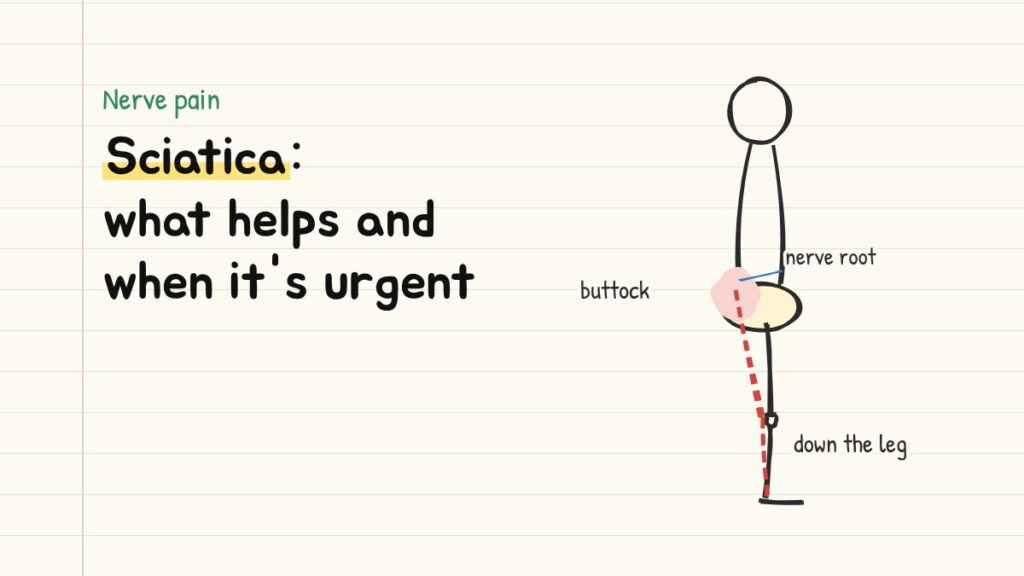
Quick answer: Sciatica is pain that travels from your lower back or buttock down one leg, usually because a nerve root in the lower spine is irritated. Most people improve over several weeks, and staying gently active usually helps more than bed rest. A few rare symptoms, like numbness in the groin or trouble peeing, need emergency care.
What sciatica actually is
Your sciatic nerve is the longest nerve in your body. It forms from several nerve roots (the branches that exit the spine) in your lower back, then runs through your buttock and down the back of each leg.
“Sciatica” isn’t a diagnosis on its own. It’s a description of symptoms. The pain usually follows a line down the back or side of the leg, sometimes into the foot. It may feel burning, electric, sharp, or achy. Some people also notice tingling, numbness, or mild weakness.
Doctors often call it lumbar radiculopathy (irritation of a nerve root in the lower back). The leg pain is often worse than the back pain.
Why it happens
The most common cause is a disc bulge or herniation. Your spinal discs are like tough, flexible cushions between the bones. Sometimes the outer layer weakens and some of the inner material pushes outward. If it presses on or irritates a nearby nerve root, you can feel symptoms down the leg.
Here’s an important detail: the pain isn’t only from pressure. Disc material can trigger inflammation (the body’s chemical response to irritation) around the nerve. That inflammation is a big part of why sciatica hurts, and it’s also why it often calms down with time.
Other causes include:
- Spinal stenosis: narrowing of the spaces where nerves travel, more common after age 50
- Spondylolisthesis: one vertebra (spine bone) slipping slightly forward on another
- Less common causes: infection, tumors, or injury, which is why red flags matter
Some people have buttock and leg pain from muscles or joints around the hip, which can feel similar. A clinician can help sort out which is which.
What usually happens over time
The outlook is usually good. Most people with sciatica improve within about 4–12 weeks, often without any procedures. That’s an estimate, and recovery varies a lot from person to person.
Research suggests that the body can gradually reabsorb herniated disc material. Imaging studies have shown that larger herniations sometimes shrink more than smaller ones. Pain doesn’t always match what a scan shows, so don’t be alarmed if you hear words like “bulge” or “degeneration.” These are very common, even in people with no pain at all.
For people whose symptoms stay severe beyond a few months, or who have significant weakness, doctors may discuss options like injections or surgery. Surgery may speed up relief for some people, but long-term results are often similar to non-surgical care. It’s a personal decision to make with a specialist.
No single therapy has been shown to make sciatica go away for good. The goal of most care is to ease symptoms and help you keep moving while your body recovers.
A short safe self-check (30–60 seconds)
This isn’t a diagnosis. It simply helps you notice your symptoms so you can describe them to a clinician. Stop right away if anything causes sharp, spreading pain.
- Trace the pain. Where does it go? Back only, buttock, above the knee, or below the knee into the foot? Pain below the knee is more typical of nerve root irritation.
- Check your feet. Standing near a wall or counter for support, rise up onto your toes, then rock back onto your heels. Is one side clearly weaker?
- Check sensation. Lightly touch both legs and feet. Does one area feel numb or different?
- Check the saddle area. Is there any numbness around your groin, inner thighs, or bottom?
If you notice any weakness, numbness in the saddle area, or changes in bladder or bowel control, read the red flags below and seek care.
Gentle things to try
1. Stay as active as you comfortably can
Bed rest used to be common advice. Now, research suggests that staying active usually leads to better recovery. You don’t have to push through severe pain. Just try to keep up light daily activities and avoid long periods lying down. Rest briefly when you need to, then get moving again.
2. Take short, frequent walks
Walking is gentle and keeps your body moving. Start with 5–10 minutes, 2–3 times a day, on flat ground. Slowly add time as you can. Stop if leg pain clearly spreads further down your leg or you feel new numbness or weakness.
3. Find positions of relief
Many people find one position eases their symptoms. Common ones include:
- Lying on your back with your calves resting on a chair or couch
- Lying on your side with a pillow between your knees
- Gently changing between sitting, standing, and walking every 20–30 minutes
Use whatever position feels easiest. There’s no single “right” one.
4. Try gentle movement within comfort
Some people find relief with gentle knee-to-chest movements or lying on their stomach propped on their elbows. Try 5–10 slow repetitions, 1–3 times a day. A good guide: if the pain moves up toward your back (called centralization), that’s often a good sign. If the pain moves further down your leg, stop that movement.
5. Use heat or cold and talk with a doctor about pain relief
A warm pack or cold pack for 15–20 minutes may ease muscle tension for some people. Protect your skin with a cloth. For medicine, speak with a doctor or pharmacist. Some common pain relievers have limited benefit for nerve pain, and the right choice depends on your health history.
When to see a doctor right away / soon
Get emergency care right away if you have:
- Numbness in your groin, inner thighs, genitals, or around your bottom (“saddle” numbness)
- New trouble starting to pee, being unable to pee, or leaking urine or stool without control
- Sciatica in both legs at the same time
- Leg weakness that is getting worse, such as foot drop (your foot slaps or drags when you walk)
- Severe back pain after a fall, car accident, or other trauma
These can be signs of cauda equina syndrome (severe compression of the bundle of nerve roots below the end of the spinal cord). It’s rare, but it needs urgent treatment.
See a doctor soon (within days) if you have:
- Fever, chills, or feeling unwell along with back pain (get checked the same day)
- A history of cancer, or weight loss you can’t explain
- Pain that is constant, severe, and worse at night
- A weakened immune system or recent IV drug use
- Symptoms that aren’t improving after 4–6 weeks
- Pain severe enough that you can’t sleep or manage daily life
FAQ
Should I get an MRI right away?
Most people with sciatica don’t need an MRI in the first few weeks unless red flags are present. Scans often show changes that don’t explain the pain and can cause unnecessary worry. An MRI may be useful if symptoms last, worsen, or if surgery is being considered.
Is sitting bad for sciatica?
Sitting can make symptoms worse for some people, especially for long stretches. Try to change position every 20–30 minutes and take short walking breaks. Others find sitting easier than standing, so follow what your body tells you.
Can sciatica come back?
Yes, symptoms can return for some people. Staying active, building strength over time, and gradually returning to heavier tasks may lower the chances. If it does come back, the same general approach often helps again.
This article is general education, not medical advice. Reviewed by Keunwoo Lee, KMD.