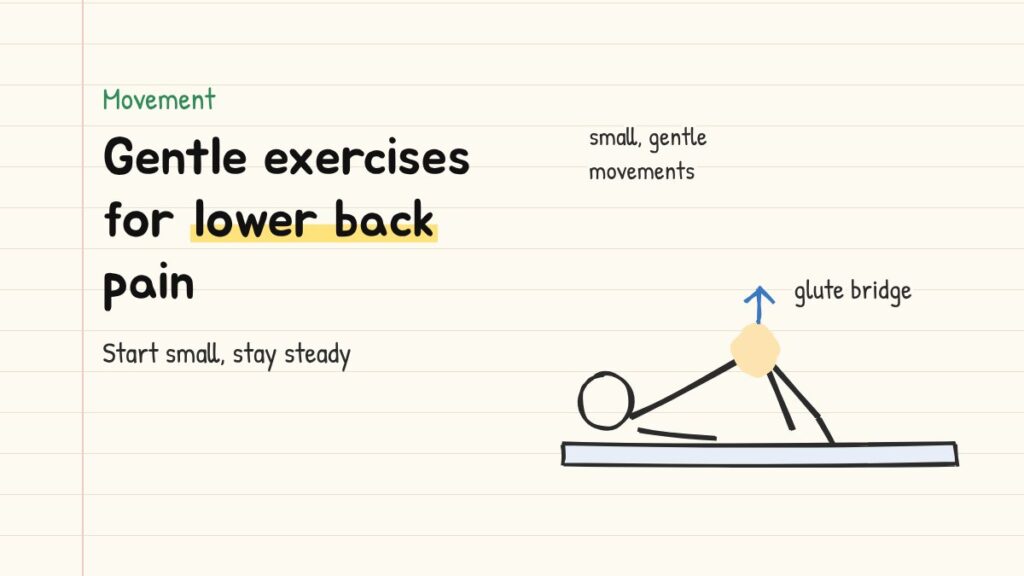
Quick answer: For most everyday lower back pain, gentle movement often helps more than rest. Walking, cat-camel, knee rocks, bird-dog, and bridges are simple options you can do at home. Start small, increase slowly, and stop if pain spreads down your leg or you notice new numbness or weakness.
Why movement helps a sore back
When your back hurts, resting feels like the safe choice. But your spine is built to move. It’s a stack of bones, discs, joints, and muscles designed to bend, twist, and carry load.
When you stop moving, a few things can happen. Muscles may stiffen and tighten up to “guard” the area. Your nervous system can become more sensitive. You may start to fear certain movements, which can make you move even less.
Gentle movement can help break this cycle. It may help blood flow to tissues, calm protective muscle tension, and shows your nervous system that movement is safe. Research suggests that staying active is one of the most helpful things for everyday back pain.
Hurt doesn’t always mean harm
This is a key idea. Feeling some discomfort during gentle exercise doesn’t usually mean you’re damaging anything. Pain is your body’s alarm system, and with back pain, that alarm is often extra sensitive.
A useful guide many clinicians use is the “traffic light” approach:
- Green (0–3 out of 10): Mild discomfort. Generally fine to continue.
- Yellow (4–5 out of 10): Moderate. Ease off a bit, slow down, or make the movement smaller.
- Red (6+ out of 10, or sharp pain): Stop that exercise for now.
It’s also okay if you feel a little sore afterward, as long as it settles within about 24 hours.
A short safe self-check (30–60 seconds)
Try this before you begin, so you know your starting point. Stop if anything causes sharp pain or pain going down your leg.
- Stand and bend forward gently, as if reaching toward your knees. Note how far you go comfortably.
- Stand and lean back a little, hands on your lower back for support. Notice how that feels.
- Turn side to side slowly, letting your arms swing.
- Rate your pain from 0 to 10.
Repeat this check after a week of exercises. Many people find they move a little more easily, even if some pain remains.
Gentle things to try
Do these on a firm, comfortable surface like a mat or carpet. Move slowly and breathe normally. You don’t have to do all five. Pick two or three that feel good.
1. Walking
Walking is simple and works well for many people.
- How: Walk at a comfortable pace on flat ground. Let your arms swing naturally.
- Dose: Start with 5–10 minutes, 1–3 times a day. Add 2–5 minutes every few days as you feel able.
- Stop if: Pain clearly increases with each step, or leg pain spreads further down.
2. Cat-camel
This gently moves your whole spine.
- How: Get on your hands and knees, hands under shoulders, knees under hips. Slowly round your back up toward the ceiling, letting your head drop (cat). Then slowly let your belly sink and lift your head a little (camel). Move only as far as feels comfortable.
- Dose: 8–10 slow repetitions, 1–2 times a day.
- Stop if: You feel sharp pain or pain traveling down a leg. If kneeling bothers your knees, place a pillow underneath.
3. Knee rocks (lower trunk rotation)
This is a gentle twist that many people find soothing.
- How: Lie on your back with your knees bent and feet flat. Keeping your shoulders relaxed on the floor, slowly let both knees drop a little to one side, then bring them back to center and go to the other side.
- Dose: 10 slow rocks each way, 1–2 times a day. Start with small movements.
- Stop if: The twist causes sharp pain. Make the movement smaller first and see if that helps.
4. Bird-dog
This builds control and endurance in the muscles around your spine.
- How: Start on your hands and knees. Keep your back flat, like a tabletop. Slowly slide one leg back and straighten it, keeping your hips level. Hold for a breath or two, then return. Switch sides.
- Dose: 5–8 repetitions per side, holding 3–5 seconds, once a day.
- Make it easier: Just slide the leg back along the floor without lifting it.
- Stop if: Your back sags or twists a lot, or you feel sharp pain.
5. Bridges
These strengthen your glutes (buttock muscles), which help support your lower back.
- How: Lie on your back with knees bent and feet flat, about hip-width apart. Gently squeeze your buttocks and lift your hips a few inches off the floor. Hold briefly, then lower slowly.
- Dose: 8–12 repetitions, holding 2–5 seconds, once a day.
- Stop if: You feel cramping in your hamstrings (back of thigh), or sharp pain in your back. Try a smaller lift.
How to progress
Once an exercise feels easy for several days in a row, you can make it a bit harder. Change only one thing at a time:
- More repetitions: Add 2–3 reps per set.
- Longer holds: Add a few seconds to bird-dog or bridge holds.
- More sets: Add a second set.
- Harder version: For bird-dog, reach the opposite arm forward too. For bridges, try a slow march, lifting one foot slightly at a time while holding the bridge.
- Longer walks: Gradually build toward 20–30 minutes most days.
Over a few weeks, consider adding everyday strength work, like squats to a chair or carrying light bags. Building overall strength may help your back handle daily life better.
Progress usually isn’t a straight line. Flare-ups are common and don’t mean you’ve failed. On bad days, go back to an easier version, then build up again.
When to stop and get checked
Stop an exercise and check in with a clinician if:
- Pain spreads further down your leg each time you do it
- You feel new tingling, numbness, or weakness
- Pain keeps getting worse over several days instead of better
When to see a doctor right away / soon
Get emergency care right away if you have:
- Numbness in your groin, inner thighs, or around your bottom
- New trouble peeing, being unable to pee, or loss of bowel or bladder control
- Weakness in one or both legs that is getting worse
- Back pain after a fall, car accident, or other injury, especially if you are older or have osteoporosis (weak bones)
See a doctor soon (within days) if you have:
- Fever, chills, or night sweats with back pain (get checked the same day)
- A history of cancer, or unexplained weight loss
- Pain that is constant and worse at night, not eased by rest or position changes
- A weakened immune system, long-term steroid use, or recent IV drug use
- Pain that isn’t improving after 4–6 weeks
- Back pain with pain or burning when you pee, which could suggest a kidney problem
FAQ
How often should I do these exercises?
Most people do well with gentle exercises once or twice a day. Walking can be done more often in short bouts. Consistency matters more than intensity, so a few minutes every day is better than one long session per week.
Should I stretch or strengthen?
Both can be helpful. Gentle movement often feels best early on, while strength exercises like bridges and bird-dog may help more over the longer term. Choose what feels comfortable and add more strength as you improve.
What if every exercise hurts?
Try making movements much smaller, or do them lying down. Walking short distances may be a good starting point. If almost all movement is painful, or pain is severe, it’s a good idea to see a clinician for a proper assessment.
This article is general education, not medical advice. Reviewed by Keunwoo Lee, KMD.