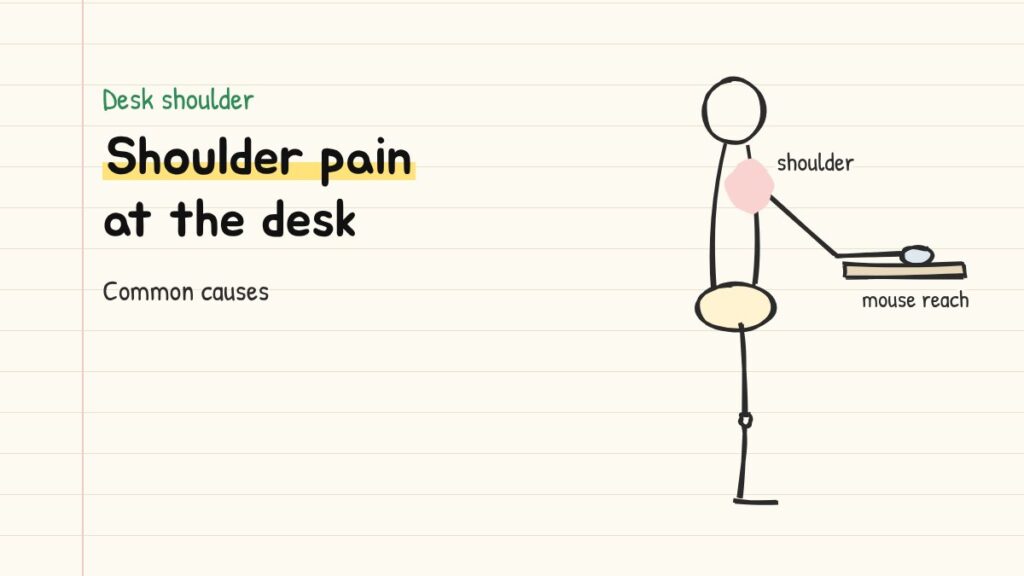
Quick answer: Shoulder pain at a desk often comes from irritated rotator cuff tendons, a mouse or keyboard that’s too far away, or pain referred from the neck. Gentle isometric and shoulder blade exercises, plus small setup changes, can help many people. Shoulder or arm pain (on either side) with chest pressure, shortness of breath, or sweating may be a heart attack and needs emergency care.
How your shoulder works
Your shoulder is the most mobile joint in your body. The ball at the top of your upper arm sits in a shallow socket, a bit like a golf ball on a tee. That shallow design lets you reach in almost any direction, but it means muscles do a lot of the work to keep things steady.
The key players are:
- The rotator cuff: four small muscles and their tendons that wrap around the joint and keep the ball centered.
- The shoulder blade (scapula): the flat bone on your upper back that glides and tilts as your arm moves. It’s the “base” your arm works from.
- The neck: nerves that supply your shoulder and arm start in your neck, so neck problems can feel like shoulder pain.
Common cause 1: Rotator cuff tendinopathy
Tendinopathy means a tendon has become irritated and less tolerant of load. It’s one of the most common causes of shoulder pain in adults.
It usually feels like an ache on the outer upper arm or front of the shoulder. It’s often worse when you lift your arm out to the side or overhead, reach behind you, or lie on that side at night.
Desk work can play a part. Holding your arm slightly forward and out to the side for hours, such as reaching for a mouse, asks the rotator cuff to work quietly without rest. Then a weekend of painting, gardening, or lifting may push the tendon past what it’s used to.
Tendons usually respond well to gradual, sensible loading over time. Complete rest often isn’t helpful, because tendons can lose tolerance when they aren’t used.
Common cause 2: Mouse and keyboard position
Your setup doesn’t directly “damage” your shoulder, but it can add steady load. Common issues include:
- A mouse placed far to the side, so your arm is held out and forward
- A keyboard too high, so your shoulders creep up toward your ears
- A laptop on a low table, pulling your head and shoulders forward
- Working without anywhere to rest your forearms
A good general rule: keep your elbows close to your sides and bent roughly at a right angle, with your forearms supported. Bring the mouse close to the keyboard.
Common cause 3: Pain coming from the neck
Sometimes the shoulder isn’t the source at all. Irritation in the neck joints or nerve roots can cause pain over the top of the shoulder, shoulder blade, or down the arm. This is called referred pain (pain felt in a different place from where it starts).
Clues that the neck may be involved:
- Moving your neck changes your shoulder pain
- Pain spreads below the elbow, or you have tingling or numbness in your hand
- Your shoulder moves freely but still aches
Other causes worth knowing
- Frozen shoulder (adhesive capsulitis): the joint capsule becomes stiff and painful, and movement in all directions is reduced. It’s more common in people aged 40–60 and in people with diabetes.
- Shoulder arthritis: more common in older adults.
- Pain from organs: the heart, lungs, gallbladder, and diaphragm can all refer pain to the shoulder or upper back. This is why red flags below matter.
A short safe self-check (30–60 seconds)
This helps you notice patterns. Stop if anything causes sharp pain, numbness, or dizziness.
- Raise both arms slowly forward and overhead. Does one side hurt or stop short?
- Raise both arms out to the side. Is there a painful zone partway up?
- Turn your head slowly left and right, then tilt each ear toward your shoulder. Does this change your shoulder or arm symptoms?
- Check your hands. Any tingling, numbness, or weakness in your grip?
If neck movement changes your pain, the neck may be involved. If your arm movement is very restricted in all directions, mention it to a clinician.
Gentle things to try
1. Adjust your setup
Bring your mouse close, lower your keyboard so your shoulders can relax, and raise your screen so the top is around eye level. Rest your forearms on the desk or armrests. Small changes often help.
2. Isometric shoulder holds
Isometrics are exercises where you push against something without moving the joint. Studies on short-term pain relief are mixed, but they are a gentle way to start loading.
- How: Stand next to a wall. With your elbow bent at 90 degrees and close to your side, press the back of your hand gently outward into the wall (outward rotation). Then face the wall and press your fist gently forward. Use about 30–50% of your effort.
- Dose: Hold 20–45 seconds, rest, and repeat 3–5 times, 1–2 times a day.
- Stop if: Pain rises above a mild 3–4 out of 10, or stays worse the next day.
3. Shoulder blade squeezes
- How: Sitting or standing tall, gently draw your shoulder blades back and slightly down, as if sliding them into your back pockets. Hold, then relax. Don’t shrug or arch your back.
- Dose: 10 repetitions, hold 3–5 seconds, several times a day.
- Stop if: You feel sharp pain or neck strain.
4. Band rows or wall slides
- Band rows: Anchor a resistance band to a sturdy post or a closed door (using a door anchor). Pull your elbows back toward your sides, squeezing your shoulder blades. 2 sets of 10–12, 3 days a week.
- Wall slides: Stand facing a wall with your forearms on it. Slowly slide your arms up as far as comfortable, then back down. 8–10 repetitions.
- Stop if: Pain is sharp, or tingling goes down your arm.
5. Take movement breaks
Every 30–45 minutes, drop your arms by your sides, roll your shoulders slowly 5–10 times, and gently turn your head side to side. Short breaks can ease the steady load on your rotator cuff and neck.
When to see a doctor right away / soon
Call emergency services right away if you have:
- Shoulder, arm (either side, though the left is more typical), jaw, or back pain with chest pressure, tightness, or discomfort
- Shoulder or arm pain with shortness of breath, sweating, nausea, or feeling faint
- Sudden, severe, tearing pain in the chest or between the shoulder blades
- Shoulder or chest pain with sudden shortness of breath or coughing up blood
- A deformed-looking shoulder or inability to move the arm after a fall or injury
- Clumsy hands, trouble with buttons, or new balance problems (possible signs of pressure on the spinal cord in the neck)
- Rapidly worsening arm weakness
Heart attack symptoms can be subtle, especially in women, older adults, and people with diabetes. If in doubt, get checked.
See a doctor soon if you have:
- A hot, red, swollen shoulder, or fever (get checked the same day)
- Unexplained weight loss, a history of cancer, or a long smoking history with new shoulder pain
- Constant pain at night that doesn’t change with position
- Sudden loss of the ability to lift your arm
- Pain or stiffness that isn’t improving after 4–6 weeks
FAQ
Should I rest my shoulder completely?
Usually not. Complete rest can make tendons less tolerant of load over time. It’s often better to reduce aggravating activities while keeping gentle, comfortable movement and gradually adding load.
Is it my shoulder or my neck?
If moving your neck changes the pain, or if you have tingling or numbness in your hand, your neck may be involved. If pain is mainly with lifting or rotating your arm, the shoulder itself is more likely. A clinician can help sort this out.
How long does desk-related shoulder pain take to improve?
Mild pain may ease within a few weeks of setup changes and movement. Tendon problems often take 6–12 weeks or longer of steady exercise. Progress tends to be gradual, with some ups and downs along the way.
This article is general education, not medical advice. Reviewed by Keunwoo Lee, KMD.